
Roller
Rack and pinion
AC
1200KG
| Availability: | |
|---|---|
| Quantity: | |
>> Introduction
The OMKER Automatic Parking Barrier Gate System is designed to control vehicle entry and exit at parking lots, residential communities, commercial premises, and other managed access points. With an electric motor drive, barrier arm mechanism, and accurate limit control, the system provides controlled opening and closing for everyday parking access management.
The barrier gate supports remote control operation and manual operation during power outages. Its spring-assisted mechanism can be adjusted to accommodate different barrier arm lengths, making it suitable for a range of vehicle entrance layouts.
For parking facility operators, property managers, and access control contractors, this automatic parking barrier gate offers a practical solution for managing vehicle movement while supporting routine installation and maintenance.
Lifting time | 5-6 seconds |
Falling time | 5-6 seconds |
Working voltage | 220V +10% 110V +10% |
Frequency | 50/60 HZ |
Working current | 1.1A |
Ambient temperature | -40°C ~+80 ° |

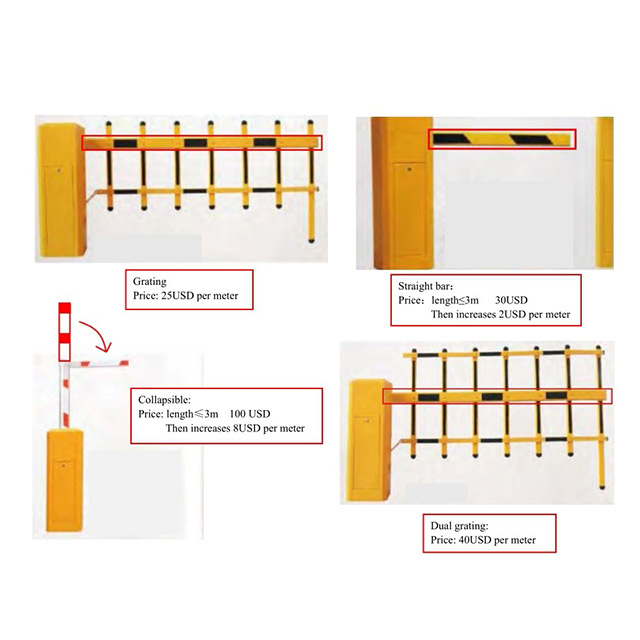
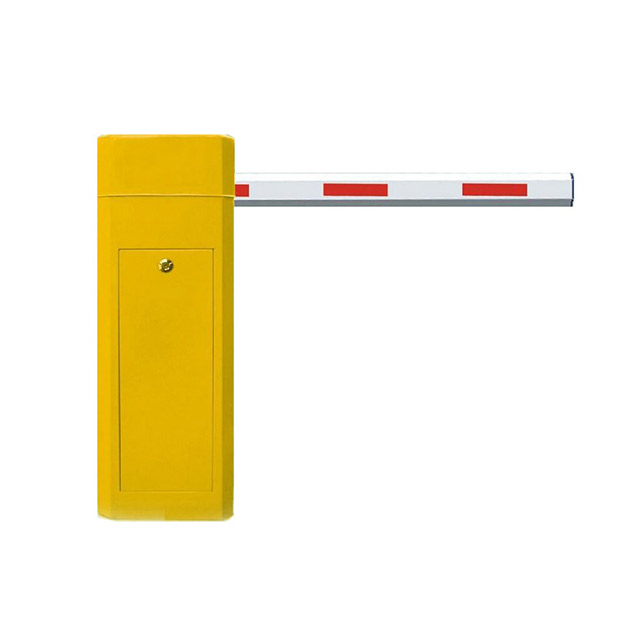
The parking barrier gate supports straight barrier arms ranging from 3 to 6 meters, allowing installers to select an appropriate arm length for the vehicle entrance.
Its adjustable spring mechanism helps balance the barrier arm according to its length. Correct spring positioning supports stable operation and reduces unnecessary mechanical strain.
The barrier gate uses a photoelectric limit control system to determine the arm's opening and closing positions.
The limit mechanism can be adjusted during installation to help the barrier arm reach its intended positions. Proper adjustment contributes to reliable operation and consistent vehicle access control.
When electrical power is unavailable, the barrier arm can be raised or lowered using the manual crank mechanism.
This feature allows authorized personnel to operate the parking barrier gate without relying on the electric motor during a power interruption.
The barrier control system supports transmitter-based operation for raising, lowering, and stopping the barrier arm.
The controller also provides transmitter learning and cancellation functions, allowing authorized personnel to configure compatible remote transmitters according to the control board instructions.
The control system includes support for vehicle detection through an induction loop detector.
Depending on the selected configuration, the detector can be used to trigger automatic barrier movement or support collision-prevention control. Proper detector installation and configuration are required for reliable operation.
Different barrier arm lengths require different spring mounting positions.
The adjustment mechanism provides multiple mounting locations to help installers balance the barrier arm. This improves mechanical stability and supports correct operation when the system is installed and adjusted properly.
For more guidance on installation preparation, barrier arm selection, and important factors to consider before purchasing, read our Barrier Gate Installation Guide. It provides additional information to help buyers and installers plan a suitable barrier gate setup.
The supplied manual identifies three mounting positions for straight barrier arms:
Position 1: 5.5–6m straight barrier arm
Position 2: 4.5–5.5m straight barrier arm
Position 3: 3–4.5m straight barrier arm
The appropriate spring position should be selected according to the installed barrier arm length and the manufacturer's instructions.
After the barrier arm is installed, qualified personnel should check the opening and closing positions.
The photoelectric limit mechanism can be adjusted to set the appropriate stopping positions. If the barrier arm does not reach the intended angle, the limit mechanism should be inspected and adjusted according to the product manual.
Installation and electrical adjustments should only be performed by qualified personnel with appropriate safety precautions.
>> FAQ
The JL-601 reference manual specifies straight barrier arms from 3 to 6 meters. The appropriate spring position should be selected according to the arm length.
Yes. The system includes a manual crank mechanism that allows authorized personnel to raise or lower the barrier arm when electrical power is unavailable.
Yes. The control system supports compatible remote transmitters, including transmitter learning and cancellation functions through the main control board.
The manual describes vehicle induction loop detector functions. The exact detection behavior depends on the connected detector and the control configuration.
License plate recognition is a function of a broader parking access control system rather than an inherent feature of the barrier motor described in the supplied manual. Buyers should confirm the availability and compatibility of any required camera or recognition equipment.
