Gate Motion
Start with the way the gate moves. Sliding gates travel along a track, while swing gates need a clear opening arc and suitable mounting geometry.
Compare sliding and swing gate opener solutions for residential entrances, commercial properties, industrial facilities, and access-control projects.
A dependable automatic gate system begins with the right operator type, suitable capacity, compatible power and controls, and a clear installation plan. OMKER helps buyers compare the essentials before selecting a model.
Start with the way the gate moves. Sliding gates travel along a track, while swing gates need a clear opening arc and suitable mounting geometry.
Gate dimensions, weight, traffic frequency, site exposure, and expected duty should guide model selection rather than appearance alone.
Plan remotes, access control, photocells, obstacle protection, limit settings, and manual release requirements as one complete system.
Explore OMKER's core gate opener categories, then use verified product pages to review the available models and application fit.
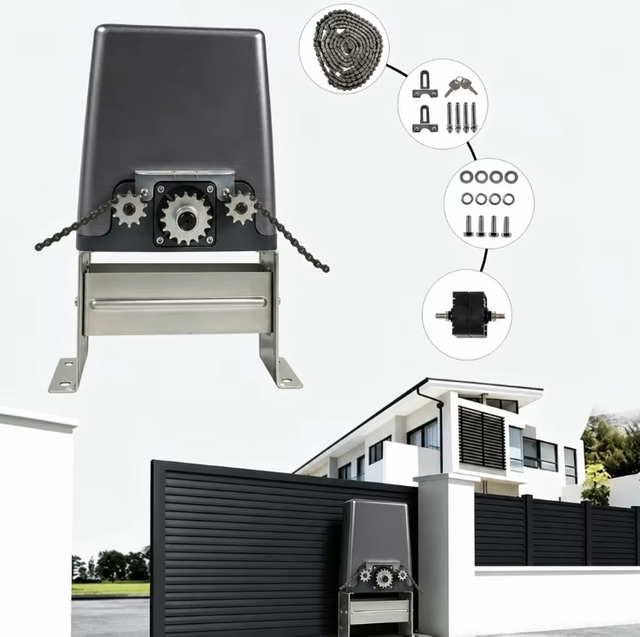
A practical choice where a gate moves horizontally and the entrance has sufficient run-back space. OMKER lists light- and heavy-duty sliding gate opener options for homes, villas, garages, factories, and industrial entrances.
View Sliding Gate Openers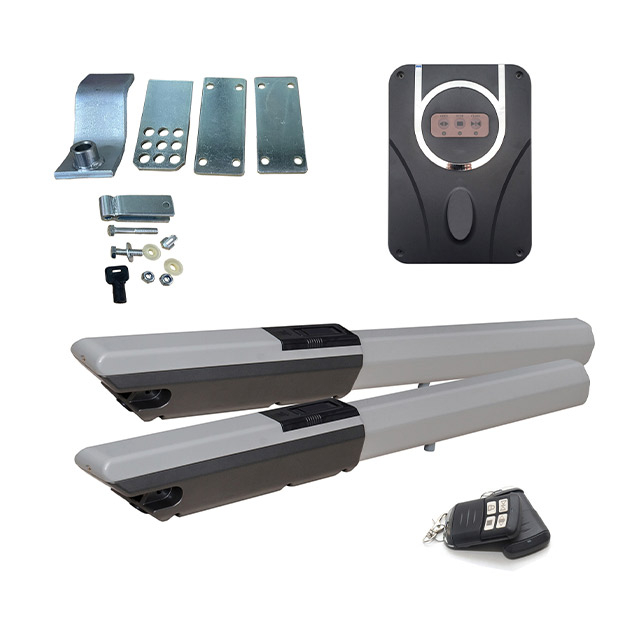
Designed for single- or double-leaf gates that open inward or outward. The category includes solutions for residential driveways, villas, hotels, farms, and commercial entrances.
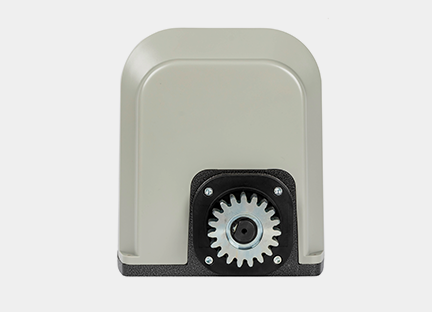
View Swing Gate OpenersAn automatic gate opener converts a manual entrance into a controlled access point. The operator, mechanical transmission, control board, remote or access-control device, safety sensors, and mounting hardware must work together.
Use this comparison as a starting point. Final selection should be based on the actual gate, site measurements, traffic pattern, electrical conditions, and installer assessment.
| Decision Factor | Sliding Gate Opener | Swing Gate Opener |
|---|---|---|
| Gate movement | Moves horizontally along the fence line or track. | Rotates inward or outward on hinges. |
| Space planning | Needs lateral run-back space beside the opening. | Needs a clear swing arc in front of or behind the gate. |
| Typical settings | Driveways, commercial entrances, industrial sites, space-constrained approaches. | Homes, villas, estates, farms, hotels, and suitable commercial entrances. |
| Site checks | Track alignment, ground condition, gate travel, rack position, and drainage. | Hinge condition, post strength, leaf geometry, opening angle, and wind exposure. |
| Model selection | Confirm gate weight and dimensions, expected cycles, voltage, controls, safety devices, environmental exposure, and local installation requirements. | |
Drivers can operate the entrance through a compatible remote or access-control method without manually moving the gate.
An automated entrance supports a more controlled arrival process for homes, staff, visitors, service vehicles, or facility traffic.
Choose the operator type and compatible accessories around the property's layout, operating needs, and control strategy.
Solutions can be considered for individual residences as well as larger commercial and industrial entrance projects.
Technical communication helps buyers clarify the gate type, load, controls, and installation requirements before ordering.
OMKER states that OEM and ODM orders are welcome, supporting distributors and project buyers with defined requirements.
Send the gate type, size, weight, voltage, usage frequency, and control requirements for a more focused discussion.
Automate daily vehicle access for houses, villas, estates, and shared residential entrances.
Support managed entry for offices, hotels, retail sites, and other business premises.
Plan motorized access for factories, warehouses, yards, and logistics entrances according to gate load and duty.
Improve vehicle access at perimeter gates where manual opening is inconvenient.
Coordinate the gate operator with the site's intended traffic and access-control workflow.
Source a suitable product category, technical documentation, accessories, and OEM/ODM discussion from one supplier.

FUJIAN OMKER Intelligent Technology Co., Ltd. states that it was established in 2006 and integrates research, production, and trade in automated door-control systems.
Provide gate type, dimensions, approximate weight, photos, power supply, site conditions, and expected usage.
Describe the intended remotes, keypad, intercom, monitoring, access-control, and safety-device requirements.
Compare the recommended opener category, model information, accessories, and installation considerations.
Agree on specifications, customization, documentation, commercial terms, and delivery arrangements before production or dispatch.
A sliding gate opener moves the gate sideways along the fence line, while a swing gate opener moves one or two leaves around hinges. The available side space, opening arc, gate structure, and site geometry usually determine the suitable type.
Share the gate type, dimensions, approximate weight, expected cycles, power supply, opening direction, site photos, environmental exposure, and preferred controls. An installer should also assess the gate structure and local safety requirements.
Compatibility depends on the selected model and control board. Tell OMKER whether the project needs remotes, a keypad, intercom, sensors, monitoring, or another access-control method so the interface requirements can be checked.
OMKER lists a Door Opener Accessories category and provides support resources. Confirm the exact operator model before ordering remotes, control boards, sensors, or other parts.
Visit OMKER's Download page for available manuals, technical files, and datasheets. If a specific file is not shown, request it with the relevant model name.
Yes. OMKER states that OEM and ODM orders are welcome. Provide the target market, product requirements, branding needs, and expected order details for evaluation.
Installation requirements vary by product and site. Follow the model-specific manual and applicable electrical and safety rules. Heavy gates, commercial projects, and complex access-control systems should be assessed and installed by qualified professionals.
Keep the gate path clear, inspect the gate hardware, track or hinges, wiring, safety devices, and manual release, and follow the product manual. OMKER also publishes gate opener maintenance guidance.
Include the gate style, dimensions, estimated weight, voltage, daily usage, desired controls, quantity, destination country, and any OEM/ODM requirements.
Fields marked with * are required. OMKER will use the submitted details to respond to your product inquiry.