01 / RETROFIT
Automate an Existing Gate
Review the leaf structure, hinge movement and lower mounting area before adding a wheel-driven operator.

Bring automatic operation to your courtyard gate with the OMKER 890 series roller swing gate motor. Its 24V DC drive moves the gate through a ground-contact wheel, while an LED running indicator provides a visible operating signal.
A roller swing gate opener depends on the relationship between the gate leaf, wheel path, ground surface and daily access pattern. Start with the site rather than selecting from specifications alone.
Review the leaf structure, hinge movement and lower mounting area before adding a wheel-driven operator.
The roller requires a firm travel path with suitable grip and manageable level variation throughout the swing.
Drainage, debris, surface condition and the mounting position all influence reliable outdoor operation.
Opening frequency, remote-control needs and single- or double-leaf operation should be defined before ordering.
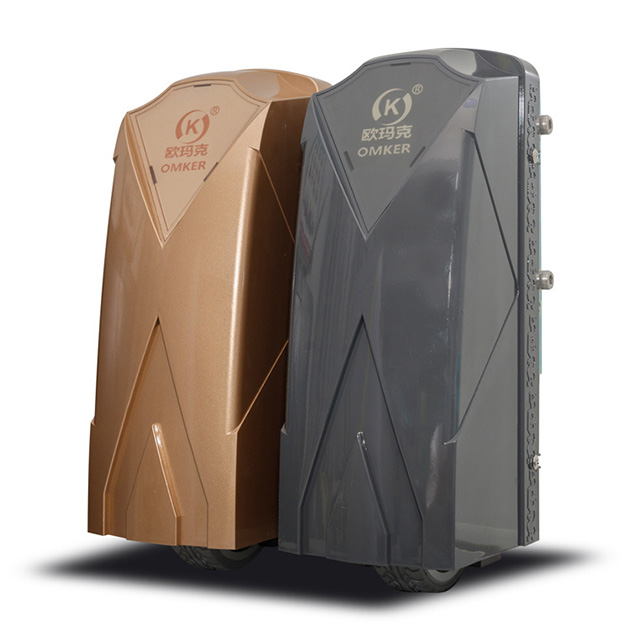
The DCK-890 mounts near the lower edge of the gate. Its motor drives a rubber roller that remains in contact with the ground, converting wheel rotation into the gate leaf's swinging movement.
Unlike a ground rail system, the roller follows the gate's natural arc. Correct contact pressure, a stable wheel path and free hinge movement are therefore central to installation quality.
The wheel path is part of the drive system. Site photos and measurements help determine whether the standard unit or an extended configuration is appropriate.
| What to check | Why it affects selection |
|---|---|
| Surface material | Concrete, asphalt or firm paving generally gives the roller a stable, grippy path. |
| Level variation | Standard allowance is 0–90mm. An extended configuration up to 300mm must be specified when ordering. |
| Slope and loose ground | Steep slopes, deep gravel and rough dirt can reduce traction and consistent wheel contact. |
| Gate movement | The leaf should swing freely without hinge binding, dragging or structural distortion. |
| Drainage and debris | Standing water, mud, stones or leaves can obstruct the roller path and should be managed. |
Product functions support routine residential and courtyard access while keeping installation requirements visible.

Controlled acceleration and deceleration help the gate move more smoothly at the beginning and end of each cycle.

DCK-890 includes an LED running indicator, giving pedestrians and drivers a visible signal while the operator is moving.

The documented configuration supports 433MHz remote control with a stated range of up to 50m under suitable conditions.

Wi‑Fi or Bluetooth mobile control is available as an option and should be matched with the selected controller when ordering.
Use the confirmed drive and electrical data as a starting point, then verify the gate and installation conditions with OMKER.

Standard ground variation allowance is 0–90mm. The configuration for up to 300mm is available upon request and must be specified when ordering.
Each application depends on a suitable roller path, gate structure and installation layout.

Remote-controlled access for decorative gates where the roller has a stable outdoor path.

Wheel-driven automation planned around daily vehicles, ground contact and gate-leaf movement.

A retrofit route for compatible gates after checking hinges, mounting space and the wheel path.

OMKER's existing application brief introduces the DCK-880 and DCK-890 for villa and courtyard swing gates. It highlights roller-driven movement, 24V DC motor operation, outdoor construction, remote control and the DCK-890 LED running indicator.
The motor mounts near the bottom of the gate and turns a ground-contact roller. As the wheel travels along the gate's swing arc, it drives the gate leaf open or closed.
It works best on a firm, stable surface such as concrete, asphalt or paving. Deep gravel, steep slopes and rough dirt paths may prevent reliable traction and wheel contact.
The confirmed difference is the running indicator: DCK-880 does not include the LED running indicator, while DCK-890 includes it.
The listed system uses a 220V input supply and a 24V DC motor. The final power configuration should be confirmed for the destination market.
Wi‑Fi or Bluetooth mobile control is optional rather than standard. Confirm the required module and compatible control configuration when ordering.
Provide the gate-leaf width and approximate weight, project quantity, installation photos, ground conditions, power requirements and preferred control method.
Installers, distributors and project buyers can share gate dimensions, ground conditions and control requirements for a configuration review and quotation.
